
- June 28, 2026
Pairing a cold plunge with a sauna is honestly one of the better recovery setups you can put together at home. And it’s not just hype. Going from intense heat straight into cold water does something to your body that neither experience can pull off on its own. Your cardiovascular system, your hormones, your nervous system all respond in a way that a single temperature just doesn’t trigger.
The research backs this up pretty consistently. Contrast therapy is said to reduce soreness in muscles, faster than the passive way of recovery. A study in the European Journal of Applied Physiology found that interchanging between heat and cold makes circulation better and reduces inflammation. People who have a Cold plunge and add a sauna with that has reported the same benefits. They sleep better and recover faster. It has made them stay consistent with their training. These things all together show good benefits over time.
This guide will help in understanding how to plan the setup, what you actually need, and how to build a contrast therapy routine that works in a home environment.
Why Contrast Therapy Works
Your body reacts strongly to temperature extremes. Heat dilates blood vessels. Cold constricts them. When you alternate between the two, you create a pumping effect in your circulatory system. Blood moves more efficiently. Waste products clear faster. Tissues get more oxygen.
That is the basic mechanism. But there is more happening at the hormonal level, too. If they are used together with proper precautions and understanding, they offer you a number of benefits. They create hormonal chemistry that helps in supporting your focus, stabilizing your mood, and also physical recovery with that. No other activity alone can do that for you.
If you want to understand the full science behind cold exposure specifically, the research behind cold water therapy science is worth reading before you build your setup. It covers what the data actually shows, without the hype.
This is why the Titan Cold Plunge and sauna combination has become one of the most popular setups for serious home recovery.
What Titan Cold Plunge Owners Are Actually Setting Up
Most Titan Cold Plunge owners who add a sauna are not doing it randomly. They are following a specific logic. Cold plunge first to reduce inflammation before heat. Or sauna first for deeper muscle relaxation, then cold to lock in the benefits and spike alertness.
The most common setups we see from the Titan Cold Plunge community include:
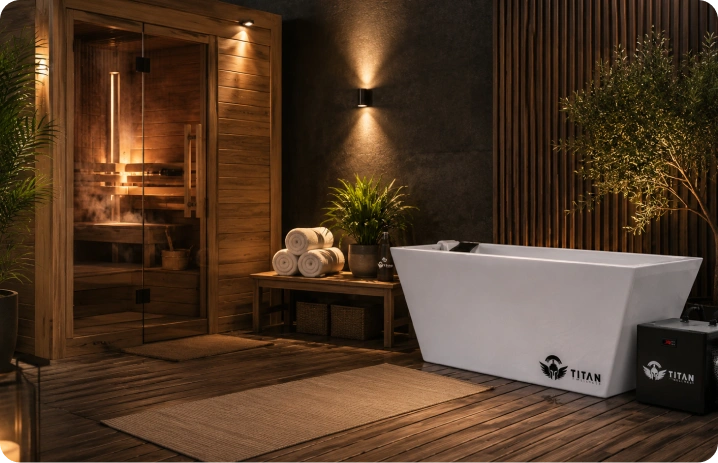
Indoor side-by-side layout — A dedicated recovery room with the cold plunge on one side and a barrel or cabin sauna on the other. Transitions between the two take under 30 seconds, which is ideal.
Outdoor deck setup — Cold plunge on a reinforced deck near a cedar outdoor sauna. This works well in climates with mild weather. It requires waterproofing and drainage planning.
Garage conversion — A finished or semi-finished garage with both units installed. This gives full privacy and year-round use. It is the most popular option among Titan Wellness owners who want a serious home gym setup.
Each layout has trade-offs. The key is planning before you buy.
Space Planning for a Contrast Therapy Home Setup
Before anything else, measure your space carefully. A contrast therapy home setup requires more room than most people expect. Here is a realistic minimum:
The Titan Cold Plunge is about 87 inches long and 34 inches wide. Keep at least 24 inches of open space on the sides so getting in and out is easy and you have room to move around it. A standard 4-person barrel sauna needs roughly 72 by 59 inches of floor space. For both units together with walking room between them, plan for at least 200 square feet. If space is tight, putting one unit at each end of the room still works fine. Use concrete, tile, or sealed epoxy for flooring since both units deal with water and humidity regularly. Sort out drainage near the cold plunge before installation because fixing it afterward is a much bigger headache.
Electrical Requirements for a Cold Plunge and Sauna Pairing
Electrical planning is where most people make mistakes, and it’s honestly the most important part to get right before anything else.
The Titan Cold Plunge needs its own dedicated circuit, either 20-amp, 120-volt or 240-volt depending on your model. Check your specs before any wiring happens. The outlet also needs to be GFCI-protected no matter what, which is basically a safety outlet that cuts power the moment water gets close to it.
A traditional sauna heater is a bigger draw, usually a 240-volt, 40 to 60-amp dedicated circuit on its own. If you’re adding both units to an existing home, have a licensed electrician look at your panel first. You might need an upgrade. Infrared saunas are simpler since many run on a standard 120-volt outlet, which makes the whole installation a lot more straightforward.
If you’re converting a garage, sort the electrical out at the start of the build. Adding circuits later costs significantly more than planning for them up front.
The Titan Sauna Duo Therapy Pro and Compatible Pairings
Titan Wellness offers solutions specifically designed for people building contrast therapy setups. The Titan Sauna Duo Therapy Pro is engineered to pair with the Titan Cold Plunge. The dimensions, power requirements, and layout are designed to work together in the same space.
For owners already in the Titan Wellness ecosystem, this is the cleanest path to a full contrast therapy setup. You are not trying to match specs from different brands. For those building a custom setup with third-party saunas, the key is matching heat output capacity, physical footprint, and electrical compatibility. Titan Wellness buyers can reach out directly to talk through compatibility. The brand is known for its Lifetime U.S.-Based Phone Support, which makes planning a paired setup more straightforward than working through a generic retailer.
Cold Plunge and Sauna Routine: How to Structure Your Sessions
A cold plunge and sauna routine does not need to be complicated. The protocol that gets the best results is simple.
Protocol 1: Sauna First
Start with 15 to 20 minutes in the sauna at 170 to 190 degrees Fahrenheit. Exit and cool down for 2 to 3 minutes. Enter the cold plunge at 50 to 55 degrees for 2 to 3 minutes. Exit and rest for 5 minutes. Repeat the cycle 2 to 3 times.
This sequence is ideal for post-workout recovery. The sauna relaxes muscles. The cold plunge reduces inflammation and spikes alertness.
Protocol 2: Cold First
Some people actually prefer starting cold rather than hot. The idea is simple, jump in the cold plunge for about 2 minutes, then move to the sauna for 15, and repeat that a couple of times. It’s an approach that tends to work well in the morning when you want to feel sharp and energized without overdoing it early in the day.
Session frequency: For most people, 3 to 4 sessions a week is a rhythm that actually holds up over time. Daily use is something experienced people do, but your body still needs time between sessions to respond and adapt properly.
If you’re new to cold exposure and still figuring out what makes sense for you, it’s worth knowing how a cold plunge and a traditional ice bath actually differ before you commit to anything.
Titan Cold Plunge Sauna Bundle: What You Get With Titan Wellness
Building a contrast therapy setup through Titan Wellness has real advantages beyond just equipment quality.
The Titan Cold Plunge sauna bundle approach means both units come with the same warranty coverage. Titan Wellness backs its products with a 2-year nationwide warranty and 30-day returns. That kind of coverage matters when you are investing in two units at once.
Shipping is free from California with fast delivery. For buyers concerned about cost, Titan Wellness accepts HSA/FSA payments, saving customers 30 to 40% on eligible purchases. The brand also offers 12-month 0% APR financing, which makes a full contrast therapy setup accessible without paying everything upfront.
With 2,000 plus 5-star reviews and a community of 50,000 plus satisfied customers, the track record speaks for itself. These are not impulse buyers. Most Titan Wellness customers are serious about their health and took time to research before buying.
For buyers who want to see what real customers are saying before committing to a dual setup, reading Titan Wellness buyer reviews gives a clear picture of what to expect from both the product and the service experience.
Common Mistakes to Avoid When Setting Up Contrast Therapy at Home
The biggest one people run into is not thinking about drainage before the cold plunge goes in. Once it’s installed and water ends up on the floor, it becomes a much bigger problem to fix. Along the same lines, running a cold plunge and a sauna on the same circuit without checking if it can handle the load is a real fire risk, so get an electrician to look at it first.
Ventilation in the sauna space is something a lot of people underestimate. A sealed room with no airflow gets uncomfortable fast and wears out materials quicker than you’d expect. Also keep the distance between your cold plunge and sauna short enough that you can move between them in under 60 seconds, otherwise you lose most of the benefit. Start with moderate temperatures when you’re new to this, around 58 to 60 degrees in the cold plunge and 160 in the sauna, and drink water between cycles because both heat and cold pull fluids out of your body faster than most people realize.
Titan Cold Plunge and Sauna: Layout and Space Planning Tips by Setup Type
Your best option is a dedicated home gym room where you have full control over the layout, flooring, and electrical setup. Garage conversions are the next most common choice and work really well as long as you budget for insulation and possibly a panel upgrade. Outdoor setups can be great in warmer climates but need a covered structure and proper weatherproofing. Small apartments can work in a pinch with a compact infrared sauna panel and a cold plunge near a bathroom drain, though it takes more creative planning.
If you’re still figuring out what makes sense for your space, the Titan Wellness team can help you work through it.
Frequently Asked Questions
Q: Can I use the Titan Cold Plunge and sauna on the same day?
Yes. That is the point of contrast therapy. Alternating between heat and cold in the same session is exactly how the protocol works. Most users complete 2 to 3 full cycles per session.
Q: How far apart should my cold plunge and sauna be?
As close as safely possible. The ideal transition time is under 60 seconds. Beyond that, you lose some of the cardiovascular response that comes from rapid temperature change. Side-by-side or same-room placement is the goal.
Q: What temperature should my Titan Cold Plunge be set to for contrast therapy?
Most users set it between 50 and 59 degrees Fahrenheit for contrast therapy sessions. Beginners should start closer to 58 to 60 degrees and work down over a few weeks.
RECENT BLOGS

- October 14, 2026
Infrared vs Steam Sauna: Which Mode Should You Use and When?
- October 12, 2026
How to Choose a Cold Plunge Chiller: 7 Specs That Actually Matter

- October 1, 2026
Common Cold Plunge Chiller Problems (and How to Avoid Buying a Bad One)

- September 30, 2026
Sauna for Detox and Skin Hydration: What Actually Works
More Blogs
Recent Blogs
Infrared vs Steam Sauna: Which Mode Should You Use and When?
- October 14, 2026
Infrared vs steam sauna comes down to heat style. Infrared warms the body directly at lower air temperatures, which suits longer, calmer sessions. Steam wraps the body in humid heat, which suits shorter, more intense ones. Research has not shown that either type is healthier, so the better mode is the one a person will use consistently. What Is the
Read More
How to Choose a Cold Plunge Chiller: 7 Specs That Actually Matter
- October 12, 2026
Here’s the thing about choosing a cold plunge chiller (often called an ice bath chiller) for home use: most people get stuck comparing tub size, price, and how good the unit looks. Fair enough, but none of that decides whether you’ll still be happy with it three months later. Seven specs do. BTU cooling capacity and horsepower tell you how
Read More
Common Cold Plunge Chiller Problems (and How to Avoid Buying a Bad One)
- October 1, 2026
Most cold plunge chiller problems start with a mismatch. The chiller doesn’t suit the tub, the climate, the power supply, or the water it has to keep clean. Buyers who check those four things before purchase sidestep many failures. This guide walks through the common problems and their causes. It also covers the checks that prevent them. What Are the
Read More
Sauna for Detox and Skin Hydration: What Actually Works
- September 30, 2026
Sauna sessions don’t detox the body, not in the medical sense anyway. The liver and kidneys handle that work. What sauna heat actually does is far more specific: it improves circulation, clears pores temporarily, and, depending on the type of sauna, can genuinely support skin hydration. Steam works better for dry skin, while infrared leans more towards circulation and recovery.
Read More