
- November 17, 2026
Fifteen to 20 minutes covers it for most healthy adults who enjoy sauna bathing. Beginners start lower, at 5 to 10. But the number moves. A traditional Finnish sauna isn’t an infrared cabin, a hotter room means a shorter stay, and the goal changes things too. What follows lays out the timing for each type of heat therapy, separates what the research supports from what it doesn’t, and spells out the signs that mean a session should end.
How Long Should a Beginner Stay in a Sauna?
Five minutes. That’s where Cleveland Clinic says a beginner should start, adding more time with each visit. Healthline gives first-timers a slightly wider window, 5 to 10 minutes. Either way, the climb is slow. The aim is to creep toward the ideal range, not leap to it.
Wondering how long to stay in an infrared sauna the first time? Cleveland Clinic suggests starting low, at around 110°F, for just 5 to 10 minutes. After that, raise the temperature and the time a little at a time, and see how you feel.
A simple build-up looks like this:
- First sessions: 5 to 10 minutes at a lower temperature.
- Following sessions: add a few minutes only after the last session felt comfortable.
- Regular use: settle at 15 to 20 minutes in a traditional sauna, or up to 20 to 30 minutes in infrared.
Drink water before the sauna and after it. That’s Cleveland Clinic’s advice, and it matters from day one, because dehydration is one of the biggest risks here. An electrolyte drink is fine too. Alcohol isn’t. And if the head starts spinning or things just feel wrong, a person can walk out early. No one needs to wait for the timer.
How Long Should You Stay in an Infrared Sauna vs a Steam Sauna?
In the infrared vs traditional sauna comparison, picture two rooms. One is a traditional sauna at 150 to 195°F. The other is an infrared cabin at 110 to 135°F. The second is easier to tolerate, since far infrared panels warm the body directly, and that’s why infrared sessions can run 20 to 30 minutes while traditional ones call for about 15 to 20. In both rooms, your core body temperature and heart rate rise, which is why session length becomes important (Harvard Health; Cleveland Clinic). Steam sessions generally stay under 30. Cleveland Clinic adds a useful reminder: hotter doesn’t necessarily mean better.
So is a sauna better than a steam room? Neither wins outright. A sauna uses dry heat and a steam room uses moist heat, and the better one is the one you enjoy and will use most often (Healthline; Harvard Health).
| Sauna type | Typical air temperature | Typical session |
| Traditional (dry) sauna | 150 to 195°F | 15 to 20 minutes |
| Infrared sauna | 110 to 135°F | 20 to 30 minutes (start at 5 to 10) |
| Steam room | High humidity | Under 30 minutes |
| Titan Sauna Duo-Therapy Pro | Up to 150°F | 15 to 30 minutes |
Some retailer pages cite 30 to 45 minutes for infrared. The medical sources reviewed here draw the line lower, putting the ceiling for experienced users near 30. So when the question is 20 minutes versus 40, the answer leans toward the shorter number.
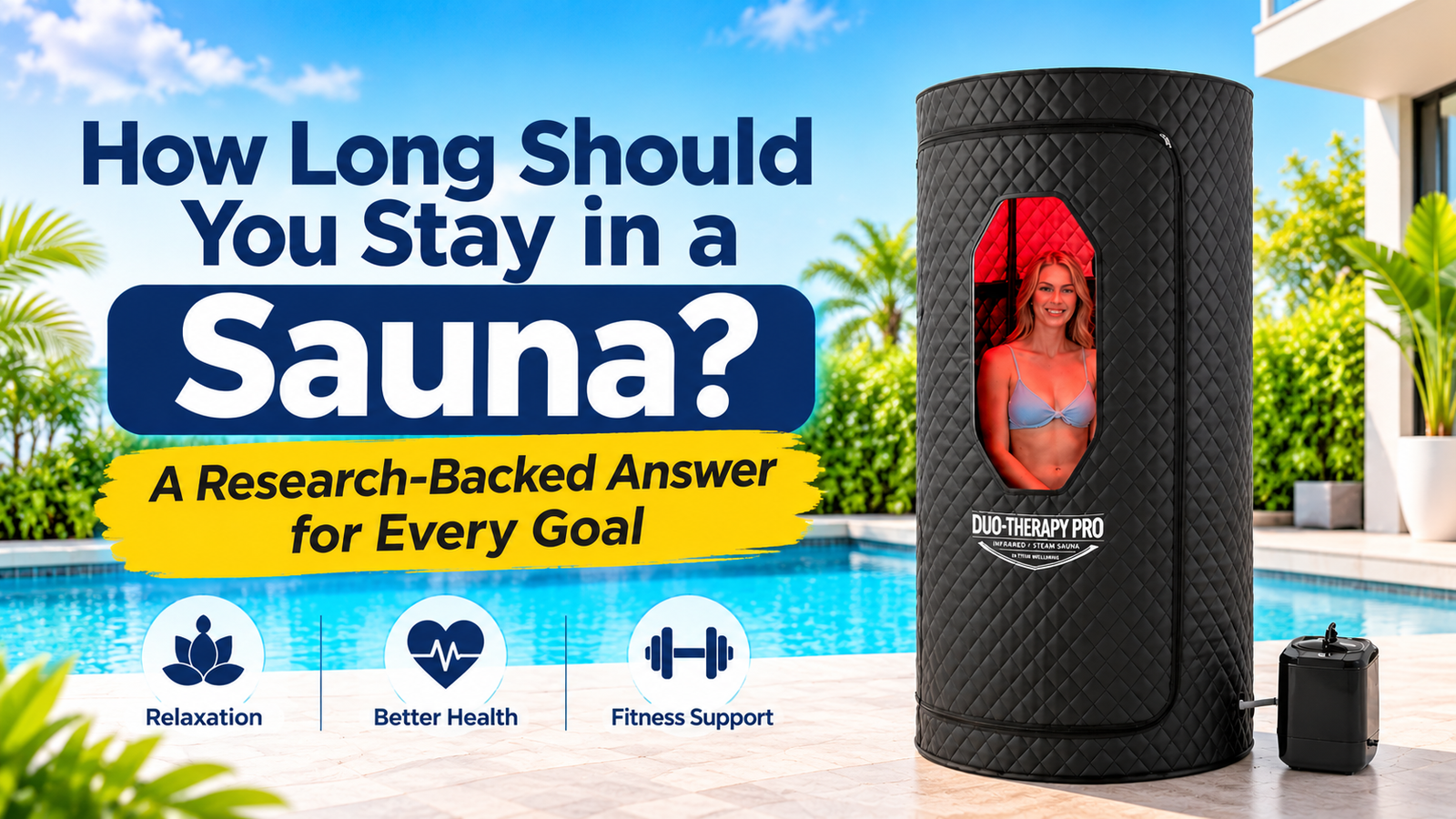
Infrared or steam? The Titan Sauna Duo-Therapy Pro is a 2-in-1 infrared and steam sauna, so it offers both, though not at once, since it runs one mode per session. It’s a portable sauna made for home use, and a sauna that plugs into a regular outlet.
As a 110V plug-in sauna, it needs no special wiring. Setup time? Plan on setup in about 10 minutes, then about 20 minutes to warm up. It reaches 150°F, and the red light therapy panel (660nm and 850nm) is built in, so it doubles as a sauna with red light therapy at home. Titan suggests 15 to 30 minutes per session. For a side-by-side look at infrared, steam and traditional, see our guide to what type of sauna is best for your health.
How Long Should You Sauna for Each Goal?
No source reviewed gives goal-specific minute targets, so 15 to 20 minutes remains the best-supported range for most goals. What differs is the strength of the evidence.
| Goal | Suggested or studied time | What the sources say | Evidence level |
| General wellness and relaxation | 15 to 20 minutes | Guidance from Cleveland Clinic and Harvard Health | Established guidance |
| Heart health | Studied: over 19 minutes, 4 to 7 sessions a week | Observational study of Finnish men in dry saunas near 174°F | Moderate (observational) |
| Muscle recovery | 15 to 20 minutes (traditional), 20 to 30 (infrared) | Heat often eases sore muscles, no duration trial in the sources reviewed | Limited |
| Stress and sleep | 15 to 20 minutes (traditional), infrared in the hours before bed | Cleveland Clinic says saunas may reduce stress and that infrared before bed may support sleep; more research is needed | Limited |
| Skin and breathing (steam) | Under 30 minutes | Wet sauna likely hydrates the respiratory tract; people sensitive to temperature changes should check with a physician | Limited |
| Weight loss and detox | No time target | No clear evidence that a sauna burns fat, weight lost in a session is water | Not supported for fat loss |
Finnish researchers followed 2,315 men for a median of 20.7 years, and the results are often quoted in talk about sauna time. Men whose sessions ran over 19 minutes had a 52% lower risk of sudden cardiac death than men who stayed under 11 minutes. The findings appeared in JAMA Internal Medicine. Two limits apply: the study was observational, and the saunas were dry ones, averaging near 174°F. Infrared wasn’t tested.
That temperature gap matters. Infrared cabins run roughly 39 to 64°F cooler than the study’s saunas, so the 19-minute marker cannot be assumed to carry over. Cleveland Clinic says more research is needed, especially on infrared. For how sweating relates to detox claims, this guide to what a sauna can and cannot do for detox adds detail.
Is 30 Minutes in a Sauna Too Long, and When Should a Person Leave?
Thirty minutes. Over the line in a traditional sauna, where the advice is 15 to 20. Right at the edge in infrared, according to Cleveland Clinic’s range for experienced users. Anyone going for it should have water, an exit plan, and a clear health history.
These signs mean a session should end right away:
- Dizziness or lightheadedness
- Weakness or nausea
- Trouble breathing or general discomfort
- Headache, muscle cramps, or confusion, which can signal dehydration
A Healthier Michigan notes that heat stroke is possible in rare cases. A person who feels unwell should leave, cool down, and drink water.
Who should not use a sauna? Some people should ask their doctor first. Cleveland Clinic says to do that if you’re under 16 or over 65, pregnant or trying to conceive, or living with a heart condition, high or low blood pressure, or epilepsy, or if you take medication. Skip the sauna altogether after a recent heart attack or stroke, or after drinking alcohol.
Titan adds a few more. Don’t use the sauna with a fever, a high sensitivity to heat, or a condition that limits sweating. And if you have an implanted device, like a pacemaker or defibrillator, get a healthcare professional’s approval first.
How Often Should a Person Use a Sauna, and Is One Long Session Better Than Short Rounds?
Frequency has a closer relationship to health results than session length and cooling breaks allow for quick rounds to stay within the recommended ranges during each visit. Men who used a sauna four to seven times a week had a 63% lower risk of sudden cardiac illness than men who used one once a week in the Finnish study.
For CHD and stroke, minimal effects of longer sessions were seen, but there was an increased association with cardiac outcomes and frequent versus infrequent yoga practice. Since it is an observational design, it indicates a correlation rather than evidence.
Rounds make the math simple. Two 15-minute rounds add up to 30 minutes of heat, yet each stay remains within the 15 to 20 minutes medical sources advise. This is arithmetic about exposure, not a claim of equal results. Titan Wellness suggests 15 minutes per round, a quick cool-down between rounds before you head back in, while Healthline describes breaks to cool off between your turns.
Cooling down matters too. Harvard Health advises cooling down gradually and drinking two to four glasses of cool water after each sauna.
What Home Sauna Combines Infrared, Steam, and Red Light?
Infrared heat, steam, red light therapy (660nm and 850nm), all in one portable unit: that’s the Titan Sauna Duo-Therapy Pro. It comes with a 2-year warranty and lifetime US-based support, you can pay with HSA/FSA funds, and financing is available at 12-month 0% APR. For a closer look, see the Titan Sauna Duo-Therapy Pro review.
Readers who pair heat with cold can also explore the sauna and cold plunge contrast therapy bundle. No verified standard sets the order or timing for contrast sessions, so a physician can advise on that.
Common Questions About Sauna Session Length
Can you stay in a sauna for an hour?
However, no source examined in this guide suggests an hour. Per medical guidance, individual sessions are limited to a maximum of 15 to 20 minutes (and at least two feet and many users take 30 minutes as experience builds). While infrared is not recommended for longer than 20 to 30 mins – again, with experience. Longer visits should be divided into rounds for a cooler break, and those who feel dizzy or weak must leave immediately.
How long does a sauna take to heat up and start working?
Heat-up time depends on the unit. The Titan Sauna Duo-Therapy Pro reaches up to 150°F in about 20 minutes. As such, Titan guidance already places most of the sweating and circulation effects within a 10-15 minute window in a session.
How long should you sauna after a workout?
No US medical source reviewed gives a separate post-workout time. Cleveland Clinic notes that sore muscles often respond to heat and describes 15 to 20 minutes as the general session length. Water before and after a session still applies.
How long should you wait between sauna rounds?
None of these were limited to a specific number of minutes by any US medical source. Healthline discusses these cooling breaks in the short intervals between rounds. And Harvard Health recommends gradually cooling down again after a sauna (to as near your normal temperature as possible). Drinking two to four glasses of cool water. Waiting until the body feels settled before re-entering is the common-sense approach.
RECENT BLOGS

- November 18, 2026
Portable Sauna vs Traditional Sauna: What Actually Matters Before You Buy
- November 17, 2026
How Long Should You Stay in a Sauna? A Research-Backed Answer for Every Goal
- November 3, 2026
Sauna Before Or After Ice Bath: Which Should I Do First?

- November 2, 2026
Infrared Saunas: What They Do and 6 Evidence-Based Health Benefits (2026 Guide)
More Blogs
Recent Blogs
Portable Sauna vs Traditional Sauna: What Actually Matters Before You Buy
- November 18, 2026
Portable sauna vs traditional sauna comes down to how the heat is made and how permanent the setup is. The permanence gap is the easier one to see. A portable unit plugs into a wall and stores away. A traditional sauna, by contrast, is a built room that heats the air to 150–195°F, according to Cleveland Clinic. Given those differences,
Read More
How Long Should You Stay in a Sauna? A Research-Backed Answer for Every Goal
- November 17, 2026
Fifteen to 20 minutes covers it for most healthy adults who enjoy sauna bathing. Beginners start lower, at 5 to 10. But the number moves. A traditional Finnish sauna isn’t an infrared cabin, a hotter room means a shorter stay, and the goal changes things too. What follows lays out the timing for each type of heat therapy, separates what
Read More
Sauna Before Or After Ice Bath: Which Should I Do First?
- November 3, 2026
Most healthy adults start with the sauna and finish with the cold plunge. Heat first makes the cold easier to enter, and ending on cold is the usual routine in contrast therapy. Here’s the useful part: the order isn’t fixed. It moves with the goal, the clock and whatever came before, like a workout. Researchers haven’t lined the two sequences
Read More
Infrared Saunas: What They Do and 6 Evidence-Based Health Benefits (2026 Guide)
- November 2, 2026
An infrared sauna warms your body directly with infrared light instead of heating the air around you. That’s why you can sweat comfortably even when the air temperature is only about 110°F to 140°F. Research on infrared saunas is also growing fast, and it points to some real upsides. Heart health, muscle recovery, and pain relief have the strongest support
Read More